A decade on, Trump returns to a stronger and more assertive China
Introduction & Background
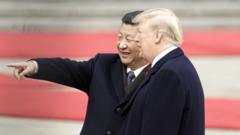
The year was 2017, and President Donald Trump had just taken office in the United States. One of his first major foreign policy moves was to meet with Chinese President Xi Jinping at Mar-a-Lago, the president's private estate in Palm Beach, Florida. The meeting was seen as a significant shift in US-China relations, with Trump pledging to work with China on issues such as trade and security. However, over the past decade, it has become increasingly clear that the Trump administration's approach to China was misguided, and that the country has emerged stronger and more assertive in the global arena.
One of the key reasons for China's resurgence is its strategic vision and long-term planning. Under Xi Jinping's leadership, China has invested heavily in key sectors such as technology, infrastructure, and energy. The country has also implemented a series of ambitious development plans, including the Belt and Road Initiative (BRI), which aims to create a vast network of trade routes and economic corridors across Asia, Europe, and Africa. As a result, China has become a major player in global commerce, with trade volumes exceeding $4 trillion annually.
China's rise has also been driven by its demographic advantages. With a population of over 1.4 billion, China has a massive workforce and a growing middle class. The country has also invested heavily in education and skills development, with a focus on emerging technologies such as artificial intelligence, robotics, and biotechnology. As a result, China has become a hub for innovation and entrepreneurship, with many of the world's top tech companies, including Alibaba, Tencent, and Huawei, based in the country.
In addition to its economic and demographic advantages, China has also made significant strides in military modernization. The country has invested heavily in new technologies, including stealth fighters, hypersonic missiles, and advanced naval vessels. China has also expanded its military presence abroad, with bases in Djibouti, Pakistan, and other countries. As a result, China is now a major player in global security, with the ability to project power and influence across the Asia-Pacific region and beyond.
Deep Global Analysis
The impact of China's rise on global markets and economies has been profound. One of the most significant effects is the shift in global trade dynamics. China has emerged as a major trading partner for many countries, including the United States, Europe, and Southeast Asia. As a result, trade balances have shifted, with China becoming a major export engine and many other countries facing trade deficits. The impact on global supply chains has also been significant, with many companies relocating production to China to take advantage of lower costs and greater efficiency.
China's rise has also had a significant impact on global financial markets. The country's economic growth has driven demand for commodities, including oil, copper, and iron ore, which has driven prices higher. China's stock market, the Shanghai Stock Exchange, has also become a major player in global markets, with a market capitalization of over $8 trillion. However, the country's financial system is also vulnerable to risks, including high levels of debt and a rapidly expanding shadow banking sector.
In addition to its economic impact, China's rise has also had significant geopolitical implications. The country's assertive foreign policy has led to tensions with neighboring countries, including Japan, South Korea, and India. China's military modernization has also raised concerns about its intentions and capabilities, particularly in the Asia-Pacific region. As a result, many countries are reevaluating their relationships with China and seeking to balance their economic interests with security concerns.
China's rise has also had significant implications for global governance. The country has emerged as a major player in international institutions, including the United Nations, the World Bank, and the International Monetary Fund. China has also launched its own initiatives, including the Asian Infrastructure Investment Bank (AIIB) and the New Development Bank (NDB), which aim to promote economic development and cooperation in the Asia-Pacific region. As a result, global governance is becoming increasingly multipolar, with multiple centers of power and influence.
Finally, China's rise has significant implications for the global environment and human rights. The country's rapid economic growth has come at a significant environmental cost, including air and water pollution, deforestation, and loss of biodiversity. China has also faced criticism for its human rights record, including restrictions on freedom of speech, assembly, and association. As a result, many countries are reevaluating their relationships with China and seeking to promote greater transparency and accountability in the country's economic and social policies.


Expert Verdict & Future Projections
According to experts, China's rise is likely to continue in the coming years, driven by its demographic advantages, strategic vision, and long-term planning. The country is expected to emerge as a major hub for innovation and entrepreneurship, with many of the world's top tech companies investing in China. China's economy is also expected to continue to grow, driven by domestic consumption and investment in key sectors such as technology and infrastructure.
However, experts also warn of significant risks and challenges associated with China's rise. The country's economic model is heavily dependent on debt and investment, which could lead to financial instability and asset bubbles. China's military modernization has also raised concerns about its intentions and capabilities, particularly in the Asia-Pacific region. As a result, many countries are reevaluating their relationships with China and seeking to balance their economic interests with security concerns.
In addition to its economic and security implications, China's rise has also significant implications for global governance. The country has emerged as a major player in international institutions, including the United Nations, the World Bank, and the International Monetary Fund. China has also launched its own initiatives, including the Asian Infrastructure Investment Bank (AIIB) and the New Development Bank (NDB), which aim to promote economic development and cooperation in the Asia-Pacific region. As a result, global governance is becoming increasingly multipolar, with multiple centers of power and influence.
Finally, experts warn of significant challenges associated with China's rise, including its environmental implications and human rights record. The country's rapid economic growth has come at a significant environmental cost, including air and water pollution, deforestation, and loss of biodiversity. China has also faced criticism for its human rights record, including restrictions on freedom of speech, assembly, and association. As a result, many countries are reevaluating their relationships with China and seeking to promote greater transparency and accountability in the country's economic and social policies.


📝 Professional
⚖️ Credits, DMCA & Fair Use Notice
- Primary Source Concept: bbc.com (Used strictly for reporting inspiration).
- Visual Media: Generated via AI & referenced from bbc.com.
- Authorship: The textual content is 100% uniquely drafted by PixelRadar AI Analytics and human experts.
Fair Use Policy: This article contains uniquely generated analysis for educational, forecasting, and news reporting purposes under the Fair Use doctrine. No copyright infringement is intended. If you are the rightful owner of any visual or conceptual material and wish for it to be credited differently or removed, please contact us. We will honor take-down requests within 24-48 hours.
📥 Join For Free Content & Communities
🚀 Join The Nextgen
🎮 Join BM Bromania
⚡ Join MR Jaguar
🔥 Join MRx Channel
⚖️ Credits, DMCA & Fair Use Notice
- Primary Source Concept: bbc.com (Used strictly for reporting inspiration).
- Visual Media: Generated via AI & referenced from bbc.com.
- Authorship: The textual content is 100% uniquely drafted by PixelRadar AI Analytics and human experts.
Fair Use Policy: This article contains uniquely generated analysis for educational, forecasting, and news reporting purposes under the Fair Use doctrine. No copyright infringement is intended. If you are the rightful owner of any visual or conceptual material and wish for it to be credited differently or removed, please contact us. We will honor take-down requests within 24-48 hours.
📥 Join For Free Content & Communities
🚀 Join The Nextgen 🎮 Join BM Bromania ⚡ Join MR Jaguar 🔥 Join MRx Channel#GlobalBreakingNews #GlobalNews #WorldUpdates #Trending #GlobalNews #MarketUpdate